Showing posts with label Indian Army. Show all posts

Wednesday, 27 June 2018

Surgical strike video released, shows ops against terror camps

On September 29, 2016, the Indian Army announced that it attacked terrorists' camps along the Line of Control using ground forces
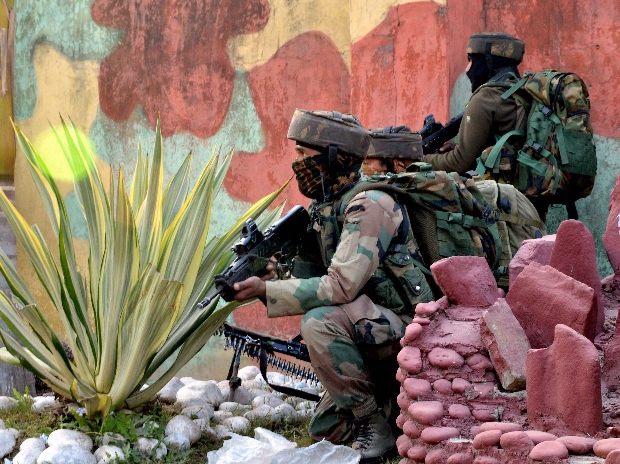
security-personnel-takes-positions-during-a-militants-attack-sunjuwan-army-camp-in-jammu-1518329015-64072240

Purported visuals of the Indian Army's cross-border operations against terrorists about two years ago were broadcast by television channels on Wednesday night.

News channels said the grainy footage on air showed gunfire and explosions targeting enemy camps in Pakistan-occupied Kashmir, an operation that came in retaliation to a terrorist strike on an Indian Army camp and is widely known as surgical strikes.

The reports also said these videos, provided to TV channels by sources, were shot by drones using thermal imaging cameras.

Business Standard could not independently verify the authenticity of the videos but an official who was directly in charge of the operation confirmed that they were real.

“When the surgical strikes happened, my view was that the videos should have been released as proof. It is good that they have come out now,” Lt General D S Hooda (retd) told The Indian Express.

On September 29, 2016, the Indian Army announced that it attacked terrorists' camps along the Line of Control using ground forces. The act, which officials said inflicted “significant casualties” on terrorists, came after a deadly attack on a military base in Uri in Jammu and Kashmir on September 18 that year.

Pakistan rejected India's claims of having launched a surgical strike on terrorist camps in Pakistani territory.

Click Here To Read More : Surgical Strike Video


Tuesday, 29 November 2016

Nagrota terror attack: 3 Army personnel killed in terror attack on army unit near Jammu

An Indian army soldier patrols along a highway on the outskirts of Srinagar
Militants in police uniform on Tuesday attacked an army artillery unit in Nagrota Attack on the outskirts of the city, killing three Army personnel, including an officer, and leaving several others injured.
There were unconfirmed reports that four militants were killed in the ensuing gunfight.
A senior Army officer said that heavily-armed militants in police uniform stormed the 166 artillery unit, opening indiscriminate fire.
An army officer and two other personnel were killed while several others were injured in the attack, the senior officer said.
A fierce gunbattle is underway at the site, a senior police officer said.
Nagrota is the headquarters of the Army's 16 corps.
1480418120-7082
In view of the attack, the Jammu-Srinagar National Highway has been closed for traffic in the area.The district administration has closed all schools in Nagorta tehsil as a precautionary measure. Read More

Thursday, 13 October 2016

JeM's Masood Azhar calls on Pakistan govt to give free hand for jihad: Report

1452693305-6293
Jaish-e-Muhammad (JeM) head Masood Azhar has called on the Pakistani government to "shows a little courage" and allow jihadist organisations a free hand in escalating their attacks in India, in order to "resolve" the Kashmir dispute, the Indian Express reported on Thursday.
According to the report, Azhar, alleged to have masterminded the Pathankot attack in January this year, was addressing the Pakistani establishment in the current issue of the JeM weekly magazine al-Qalam.
Quoting Azhar, the national daily's report said: “If the government of Pakistan shows a little courage... The problem of Kashmir, as well as the dispute over water, can be resolved once and for all right now. If nothing else, the government simply has to open the path for the mujahideen. Then, god willing, all the bitter memories of 1971 will be dissolved into the triumphant emotions of 2016."
The appeal was meant to stir up memories of Pakistan's defeat in the 1971 Bangladesh liberation war, where Indian armed forces and the Bangladeshi Mukti Bahini handed the Pakistani armed forces in then East Pakistan a decisive defeat, a historical event which still feeds into the bellicose narrative of those like Azhar and Jamaat-ud-Dawah chief Hafiz Saeed.
Jihadist policy has "damaged" India
Lobbying for greater role and freedom for terrorist organisations like the JeM, Azhar, according to the national daily, wrote that jihad by Pakistan-based organisations had left “every one of its (India's) limbs badly injured”.
Touting the success of jihad as a military strategy, Azhar added, “What remained of its military prowess was exposed in Pathankot and Uri." Read Full Story
ALSO READ:
Continued jihad in Kashmir

Thursday, 6 October 2016

Surgical strikes achieve tactical closure, not strategic detente: Former NATGRID CEO

1475636390-8086
Military power is never about the number of troops, tanks, ships or aircrafts. If military power was all a country needed to establish superiority, America would not have been beaten by Vietnam, the Soviet Union would not have been routed by Afghan tribes and the juggernaut that is the Indian Army would not have been held at bay by a few thousand Tamil Tigers in Sri Lanka.
A country’s military power is actually determined by a combination of economic realities, governance frameworks, national will and strategic thinking – which work together to deliver a punch worthy of its weight.
Comparing India’s military power to Pakistan’s from this perspective actually yields a startling conclusion.
In 1999, Pakistan’s army chief at the time was mid-air when Prime Minister Nawaz Sharif decided to sack him. Surgical Strikes Denied permission to land in Pakistan and faced with the option of making an emergency landing on Indian soil, the sacked general decided to land in Karachi anyway. He communicated his orders to his military subordinates through the civilian aviation channel and by the time his plane landed, Pervez Musharraf was firmly back in the saddle while Sharif had been toppled off his. That is the power of the Pakistani military.
Now compare the Pakistani army’s swiftness to India’s handling of the Kandahar hijacking in 1999. When the Indian Airlines flight was taken over by terrorists and parked in Amritsar over the course of its long journey, the Indian establishment could not decide between blocking the aircraft’s departure or letting it go. That ambivalence cost India the advantage it had in being able to control events happening on its own turf. Read More
Three nuances of national strength
Three strategic realities India cannot overlook
Using economic leverage to influence Pakistani economy
Expose and target value chains of Pakistan’s military businesses
Combine ‘strategic depth’ with ‘strategic stretch’
Article Source : Business Standard

Wednesday, 5 October 2016

Two terrorists killed in Jammu and Kashmir's Handwara, search ops on

army-kashmir-patrol-loc-pti
Two terrorists were killed in Jammu and Kashmir's Handwara district on Thursday morning after they opened fire outside the 30 Rashtriya Rifles camp at Langate. The terrorists, who were in army combat uniform, had opened fire at around 5 a.m.
During the search operation in the area, the militants opened fire at the forces. The firing continued for 10 to 15 minutes. Since the troops were alert, the attack was aptly retaliated by the security forces. The operation is currently underway.
Meanwhile, additional forces have been rushed to the spot to nab the remaining terrorists.
No casualties have been reported, so far. Meanwhile, it is reported that the army foiled three infiltration bids along the LoC in Jammu and Kashmir last night. Two infiltration bids were foiled in Naugam Sector while one such attempt was foiled in Rampur sector.
The attack comes days after terrorists attacked a BSF and adjoining camps in Baramulla district, where one Bolder Security Force (BSF) soldier was killed in the attack.
The attack also comes after the Indian Army conducted surgical strikes and destroyed seven terror launch pads across the Line of Control (LoC), last week.
Last month, terrorists had attacked the army brigade headquarters at Uri, killing 19 soldiers.
Also Read:

Friday, 30 September 2016

Surgical strikes: How the world conducts them and how India did it

1464334004-7087
Indian armed forces conducted surgical strikes in the early hours of Thursday across the Line of Control (LoC), involving not more than 100 commandos, in what is seen as a paradigm shift in how this government plans to deal with terrorist camps across the border.
The term "surgical strike" has been prevalent in the international media since the days of the Gulf War, and it came to typify operations conducted by the US thereafter.
Going by the generally accepted definition offered by experts, a surgical strike comprises a swift, intelligence-driven attack on a specific target or targets with minimum collateral damage to structures, infrastructure or civilians in the target's vicinity.
The operation can involve special forces units on the ground, strikes conducted by military aircraft or vessels. Read More
How India conducted its strikes
How the big hitters do it
Article Source : Business Standard

Thursday, 29 September 2016

India strikes back as Army conducts surgical strikes across LoC in Pakistan

1474467249-386
The Indian Army conducted surgical strikes across the Line of Control (LoC) on Wednesday night on launchpads where terrorists had amassed and positioned themselves to infiltrate into India, Director General Military Operations (DGMO) Lt Gen Ranbir Singh informed the gathered members of the press at the joint briefing following the Cabinet Committee on Security meeting held on Thursday.
According to Times Now, a total of eight surgical strikes were conducted by the Indian Army. There were no Indian casualties during the operation.
Singh said that the strikes were based on credible information and that the terrorists were poised to conduct attacks in Jammu and Kashmir and other major metros in the country. Singh revealed that significant casualties were inflicted on the terrorists in the operation.
The DGMO added that he had contacted his Pakistani counterpart to inform him of the operation conducted by the Indian armed forces on Wednesday night.
"It has been a serious matter of concern that there has been continuing and increasing infiltrations by terrorists across the LoC in Jammu and Kashmir. This is reflected in the terrorist attacks at Poonch and Uri on September 11 and 18, respectively. Almost 20 infiltrations attempts have been foiled by the Indian Army successfully this year. During these attacks and infiltration attempts, we have recovered items, including global positioning systems and stores which have had Pakistani markings," the DGMO added.
Further, the DGMO said that Pakistani-origin terrorists, who have been captured, have also provided testimonies of their training in Pakistan. Read More
Also Read:

Article Source : Business Standard

Wednesday, 27 July 2016

Who is Irom Sharmila? Ten things to know

1397728066-1297
Fifteen years after civil rights activist, Irom Sharmila, began a fast seeking the repeal of AFSPA, she is set to end it on August 9. She also announced her decision to fight elections as an independent candidate in the Manipur polls, early next year.
“I will end my fast on August 9 and contest elections on an independent ticket," Sharmila said. She had just come out of a local court after attending a trial for attempting suicide.
Business Standard lists out ten things to know about the Iron Lady of Manipur.
How did it all start?

Monday, 22 February 2016

Air force, DRDO, pleased with Tejas performance at Bahrain


In a milestone for India’s Tejas light-combat aircraft (LCA), two Tejas fighters travelled from India to performed aerobatics at the Bahrain International Air Show (BIAS-2016) from January 21-23.

Business Standard has obtained the first official account of this first international outing, where the Tejas impressed global aerospace experts, taking an important first step towards export in the future. Read More

Triple Talaq: Patriarchy not just a 'women's issue', marriage no holy cow

From academic jargon, the word 'patriarchy' has come a long way in the Indian public sphere. But it has a long way to go yet ...